

Featured Publications

PREP-aring is worth it: Success of the Case Western Reserve University Postbaccalaureate Research Education Program and its Scholars
Dana C. Crawford, Esteban Vazquez-Hidalgo, Hua Lou The National Institute of General Medical Sciences (NIGMS) Postbaccalaureate Research Education Program (PREP)* was a research-intense, one-year training program for recent college graduates from experiential backgrounds uncommon in science who intended to matriculate with a PhD program in preparation for a career in biomedical research. Case Western Reserve […]
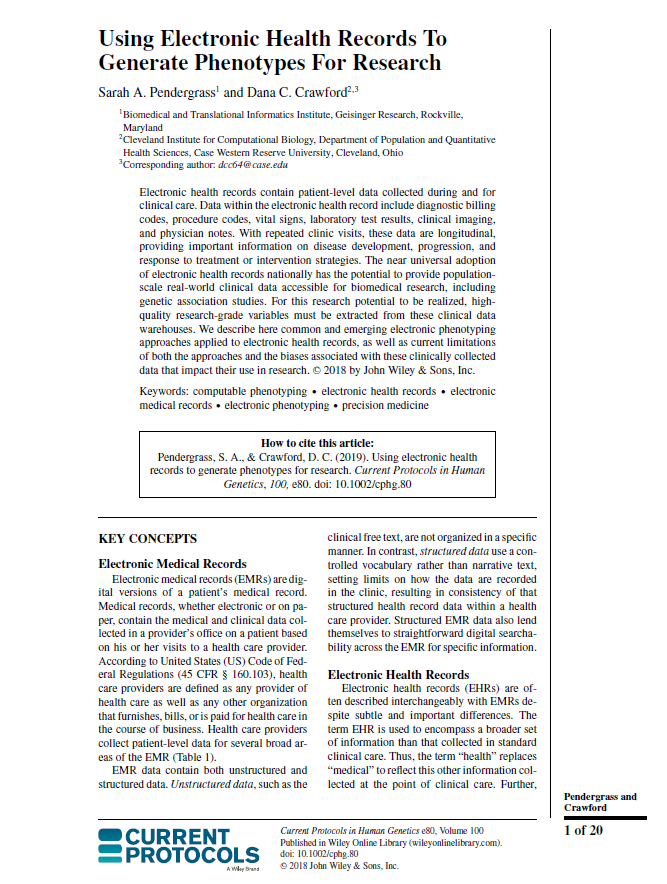
Using Electronic Health Records to Generate Phenotypes for Research
Sarah A. Pendergrass and Dana C. Crawford Electronic health records contain patient-level data collected during and for clinical care. Data within the electronic health record include diagnostic billing codes, procedure codes, vital signs, laboratory test results, clinical imaging, and physician notes. With repeated clinic visits, these data are longitudinal, providing important information on disease development, […]
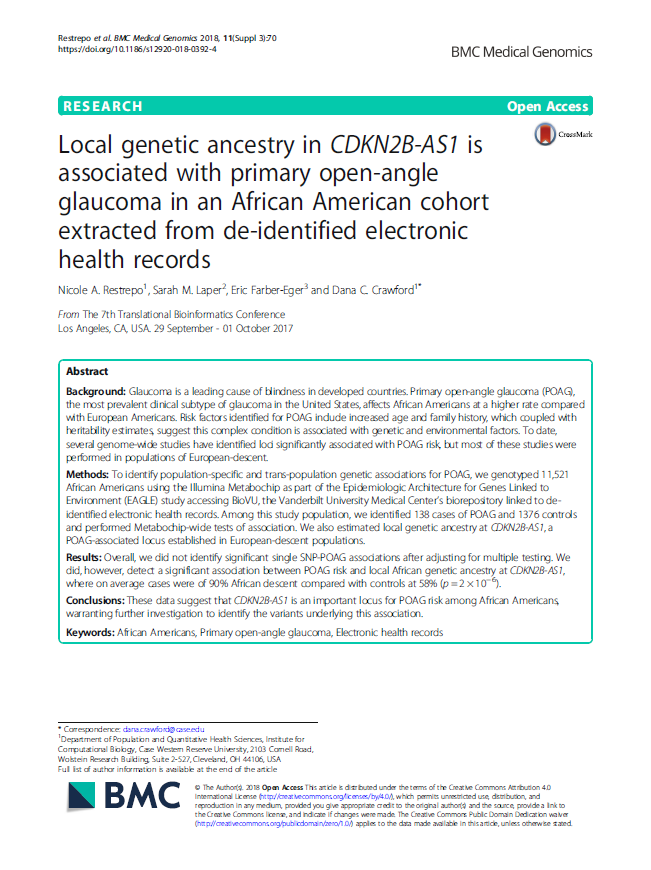
Local genetic ancestry in CDKN2B-AS1 is associated with primary open-angle glaucoma in an African American cohort extracted from de-identified electronic health records.
Restrepo NA, Laper S, Farber-Eger E, Crawford DC. Glaucoma is a leading cause of blindness in developed countries. Primary open-angle glaucoma (POAG), the most prevalent clinical subtype of glaucoma in the United States, affects African Americans at a higher rate compared with European Americans. Risk factors identified for POAG include increased age and family history, […]
Reducing Clinical Noise for Body Mass Index Measures Due to Unit and Transcription Errors in the Electronic Health Record.
Goodloe R, Farber-Eger E, Boston J, Crawford DC, Bush WS,. Body mass index (BMI) is an important outcome and covariate adjustment for many clinical association studies. Accurate assessment of BMI, therefore, is a critical part of many study designs. Electronic health records (EHRs) are a growing source of clinical data for research purposes, and have […]